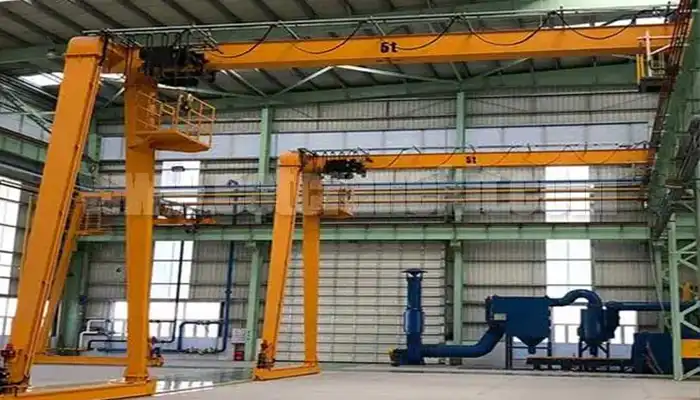
How to Select a Semi Gantry Crane for Existing Workshops
menu_open
Content Quick Link
Learn how to choose a semi gantry crane for existing workshops, focusing on retrofit projects, low ceiling limitations, and floor condition requirements.
Key Takeaways
- Existing workshop conditions are often more important than crane capacity.
- Check ceiling height, floor condition, and building layout before selecting a crane.
- Low-headroom designs can maximize lifting height in low-ceiling workshops.
- Floor strength determines whether rail-mounted or rail-free travel is feasible.
- Semi gantry cranes are often the most cost-effective retrofit solution for existing facilities.
Why Choose a Semi Gantry Crane for a Retrofit Project?
Many workshops were not originally built with overhead lifting equipment in mind. As production grows, companies often need a safer and more efficient way to handle heavy materials, machinery, molds, or fabricated components. Installing a full overhead crane can be expensive and may require major building modifications. A semi gantry crane offers a practical alternative. Because one side of the crane travels on the floor while the other side runs on an elevated runway, a semi gantry crane can often be installed in an existing workshop with fewer structural changes.
Common Reasons for Retrofitting
Add Lifting Capability Without Major Building Modifications
One of the main reasons companies choose a semi gantry crane is to add lifting capacity without rebuilding the workshop.
Many existing buildings do not have the structure needed to support a full bridge crane system. Rather than installing new columns, runway beams, and roof reinforcements, a semi gantry crane can often work with the existing building layout.
Benefits include:
- Lower installation costs
- Less construction work
- Shorter installation time
- Reduced production interruptions
- Better use of existing workshop space
This is especially common in steel fabrication shops, machine workshops, maintenance facilities, and manufacturing plants.
Replace Forklifts for Heavy Material Handling
Forklifts are useful for moving pallets and packaged goods. However, they become less efficient when handling long, heavy, or oversized loads.
Common examples include:
- Steel plates
- Steel beams
- Machine components
- Injection molds
- Fabricated structures
- Industrial equipment
A semi gantry crane lifts loads above the work area instead of moving them through busy aisles. This can improve safety and reduce congestion on the shop floor.
Increase Workshop Productivity
Material handling often becomes a bottleneck as production increases.
Workers may spend time waiting for forklifts, repositioning loads, or moving materials between workstations. A semi gantry crane provides dedicated lifting coverage where it is needed most.
This can help:
- Speed up material movement
- Reduce handling time
- Improve workflow
- Support machine loading and unloading
- Reduce dependence on forklifts
For many workshops, smoother material flow means higher daily output.
Expand Production Capacity
When new machines are added or production volume increases, existing handling methods may no longer be sufficient.
Instead of moving to a larger building, many manufacturers upgrade their lifting equipment first.
A semi gantry crane can support:
- Additional production lines
- Larger workpieces
- Heavier loads
- Expanded assembly areas
- New processing equipment
This allows companies to make better use of their existing facility.
Why Semi Gantry Cranes Work Well
Lower Installation Costs Than Overhead Cranes
Compared with a traditional overhead crane, a semi gantry crane usually requires less supporting steel and fewer building modifications.
Potential savings may come from:
- Structural steel
- Runway construction
- Building reinforcement
- Installation labor
- Civil works
For many retrofit projects, these savings make the project financially feasible.
Minimal Structural Changes
Older workshops often have limitations such as low roof heights, light building structures, or aging steel frames.
Because part of the crane load is carried through the floor-supported leg, the building structure carries less load than with a full overhead crane.
This can reduce or eliminate the need for:
- Roof reinforcement
- Additional support columns
- Major structural upgrades
- Extensive engineering modifications
Flexible for Existing Workshop Layouts
Every workshop is different. Existing facilities often contain fixed machines, storage racks, workstations, and structural columns that cannot be relocated.
A semi gantry crane can be customized to fit these conditions through:
- Single girder or double girder designs
- Low headroom configurations
- Rail-mounted systems
- Rail-free wheel-traveling systems
- Custom spans and travel lengths
This flexibility makes semi gantry cranes one of the most practical lifting solutions for existing workshops where space, budget, and building limitations must all be considered.
Evaluate Your Existing Workshop First
Before selecting a semi gantry crane, half gantry crane, or single girder semi gantry crane, the first step is to evaluate the existing workshop conditions. This is especially important for crane retrofit projects where the building already contains machinery, storage areas, production lines, and structural obstacles.
A proper site survey helps determine the right crane span, lifting height, travel length, and crane configuration. It can also prevent costly installation issues later.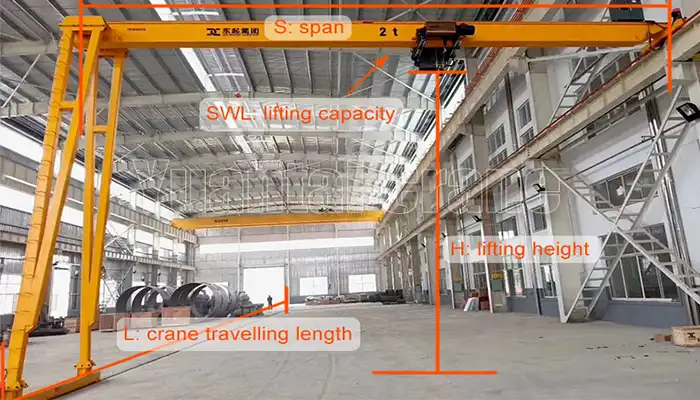
Building Dimensions
The dimensions of the workshop directly affect the design of the semi gantry crane system. Whether you are considering a 3 ton semi gantry crane, 5 ton half gantry crane, or 10 ton single girder gantry crane, accurate measurements are essential.
Workshop Width
Workshop width is one of the main factors used to determine crane span.
Measure:
- Total workshop width
- Distance between building columns
- Width of production aisles
- Areas requiring crane coverage
For many semi gantry crane retrofit projects, the crane only needs to serve a specific work zone rather than the entire building. For example, a single girder semi gantry crane may only be required to cover a fabrication bay, machine loading area, or assembly station.
When evaluating workshop width, consider:
- Future production expansion
- Material flow paths
- Safe clearance around equipment
- Hook approach requirements
Workshop Length
Workshop length determines the required crane travel distance.
Measure:
- Total building length
- Material handling routes
- Distance between workstations
- Loading and unloading points
A half gantry crane used for steel fabrication, machine shops, or maintenance workshops often travels along a dedicated production area. The crane runway length should cover all locations where materials need to be lifted and transferred.
Available Lifting Area
The available lifting area is often smaller than the actual workshop size.
Identify:
- Machine operating zones
- Assembly areas
- Storage locations
- Material staging areas
- Inspection stations
This information helps determine the effective coverage area of the semi gantry crane rather than simply using building dimensions.
For example, a 5 ton semi gantry crane used for machine maintenance may only require coverage over several CNC machines, while a workshop handling steel structures may require coverage across an entire fabrication line.
Floor-to-Ceiling Height
Ceiling height is one of the most important measurements when selecting a semi gantry crane for an existing workshop.
Measure:
- Floor-to-roof height
- Floor-to-bottom of roof trusses
- Floor-to-lowest overhead obstruction
These dimensions affect:
- Maximum lifting height
- Hook travel
- Hoist selection
- Crane girder design
- Low headroom crane requirements
Many retrofit projects involve low ceiling buildings. In these situations, buyers often choose a low headroom semi gantry crane or double girder half gantry crane to maximize usable lifting height.
If lifting large machinery, molds, steel components, or production equipment, every inch of hook height matters.
Existing Obstacles
Most existing workshops contain obstacles that influence crane selection and installation. These must be identified before finalizing the crane design.
Building Columns
Columns are one of the most common restrictions in semi gantry crane applications.
Check:
- Column locations
- Column spacing
- Column dimensions
- Clearance between columns and equipment
Column placement can affect:
- Crane span
- Runway layout
- Load handling path
- Safe operating clearance
In some workshops, the maximum span of the single girder semi gantry crane is determined by column spacing rather than building width.
Machines and Production Equipment
Large machinery can create physical barriers for crane operation.
Common examples include:
- CNC machining centers
- Press machines
- Injection molding machines
- Welding equipment
- Cutting machines
- Rolling machines
Record the location, height, and footprint of all major equipment.
This information helps ensure the semi gantry crane can move loads safely without interfering with production activities.
Mezzanines
Many factories use mezzanine structures for storage, offices, or utility equipment.
Evaluate:
- Mezzanine height
- Support column locations
- Clearance underneath
- Access routes
A mezzanine can reduce available lifting height and may limit the operating range of a half gantry crane.
Pipes and Cable Trays
Overhead utilities are frequently overlooked during crane planning.
Inspect for:
- Fire sprinkler systems
- Water pipes
- Compressed air lines
- Electrical cable trays
- Lighting fixtures
These systems can reduce available headroom and affect the design of a low headroom semi gantry crane.
HVAC Systems
Heating and ventilation equipment often occupies valuable overhead space.
Check for:
- Air ducts
- Exhaust systems
- Ventilation pipes
- Air handling units
The position of HVAC equipment should be considered when determining crane height and hoist travel.
Practical Site Survey Checklist for Semi Gantry Crane Selection
Before requesting a quotation for a semi gantry crane, half gantry crane, or single girder gantry crane, collect the following information:
- Workshop width
- Workshop length
- Floor-to-ceiling height
- Required lifting height
- Crane travel length
- Building column layout
- Machine locations
- Mezzanine locations
- Pipe and cable tray locations
- HVAC system locations
- Workshop layout drawings
- Site photographs
- Load weight and dimensions
A detailed site survey allows crane manufacturers to recommend the most suitable semi gantry crane configuration, whether it is a single girder semi gantry crane for light-duty lifting, a low headroom half gantry crane for limited ceiling height, or a heavy-duty double girder semi gantry crane for larger loads and higher duty cycles.
Selecting a Low Headroom Semi Gantry Crane for Low Ceiling Workshops
When dealing with an existing workshop, especially older factory buildings or retrofit projects, ceiling height becomes one of the main limits. A low headroom semi gantry crane is often used in these cases because it helps recover lifting height that would otherwise be lost in the structure.
In real industrial layout work, the difference between a standard setup and a low headroom design can decide whether the crane can actually lift the load to the required height or not.
Why Headroom Matters in Semi Gantry Crane Selection
Low ceiling workshops are common in steel fabrication shops, maintenance bays, and older manufacturing plants. The problem is simple: the available vertical space is already consumed by roof structure, lighting, pipelines, and ventilation systems. So when a semi gantry crane or half gantry crane is installed, the remaining lifting height becomes limited.
Impact of Limited Headroom
In practice, headroom directly affects:
- Maximum hook height
- Ability to lift tall equipment or molds
- Machine loading and unloading clearance
- Safe lifting operation under roof obstructions
If headroom is not checked properly, even a correctly rated single girder semi gantry crane may not achieve the required lifting height. That is a common issue in retrofit crane projects.
Floor to Roof Height
This is the total structural height of the workshop.
Measure from:
- Finished floor level
- To the underside of roof structure
This gives a general idea of space availability, but it is not enough on its own.
Floor to Lowest Obstruction
This is more important in practical design.
Check the lowest point of:
- Steel roof trusses
- HVAC ducts
- Fire sprinkler pipes
- Cable trays
- Lighting systems
This value defines the real working ceiling for a semi gantry crane system.
In many retrofit projects, this is where designers discover that actual usable height is much lower than expected.
Required Lifting Height
This depends on what the crane will handle in daily operation.
Typical cases include:
- Lifting steel plates in fabrication workshops
- Handling CNC machine parts
- Mold installation and removal
- Maintenance lifting of heavy equipment
You should define:
- Maximum lifting height required
- Hook travel range needed
- Clearance above the load
Without this, it is impossible to correctly size a low headroom semi gantry crane or half gantry crane system.
Recommended Solutions for Low Headroom Semi Gantry Crane Applications
Different crane structures can be used depending on how tight the ceiling condition is. The goal is always the same: maximize hook height while keeping the structure stable and safe.
Low Headroom Hoists for Semi Gantry Crane Systems
Low headroom electric hoists are one of the most common solutions in retrofit crane projects.
They are designed to reduce the vertical space between the girder and hook.
Key advantages:
- Increase effective lifting height in low ceiling workshops
- Reduce wasted vertical space above the hook
- Improve usability in tight industrial environments
- Suitable for 3 ton, 5 ton, and 10 ton semi gantry crane setups
In many cases, switching from a standard hoist to a low headroom hoist can recover valuable lifting height without changing the building structure.
This is often the first step in improving a semi gantry crane layout in low clearance workshops.
Double Girder Semi Gantry Crane Designs
A double girder configuration is often used when higher lifting height and better hook approach are required.
Compared with a single girder semi gantry crane:
- The hoist runs on top of the girders instead of below
- Hook can reach higher positions
- Better control for heavy-duty lifting tasks
This type is commonly selected for:
- Steel structure workshops
- Heavy machinery installation
- Mold handling operations
- Industrial maintenance workshops with limited height but heavier loads
In low ceiling conditions, it may sound counterintuitive, but a properly designed double girder semi gantry crane can actually improve usable lifting height.
Compact Crane Components for Retrofit Projects
When workshop space is tight, every structural millimeter matters.
Compact crane design helps reduce unnecessary height loss.
Typical design improvements include:
- Low-profile hoists to reduce hook dead space
- Compact end carriages to minimize overall crane height
- Optimized girder section design for better clearance
- Reduced structural depth in runway connection areas
These adjustments are often used in customized semi gantry crane and half gantry crane systems designed for existing workshops where no structural modification is allowed.
In practical terms, compact design is not about appearance. It is about fitting the crane into the available space without reducing lifting performance.
Practical Note for Workshop Retrofit Projects
In real installation work, many buyers underestimate how much ceiling structure affects crane performance.
A workshop may look tall enough at first glance. But after measuring pipes, trusses, and lighting systems, usable height is often reduced by a noticeable margin.
That is why low headroom semi gantry cranes are not just an option—they are often the only workable solution in retrofit crane installations.
A proper design starts from measurement, not from crane selection.
Assess Floor Conditions Before Installing a Semi Gantry Crane
In any semi gantry crane, half gantry crane, or single girder semi gantry crane project, the floor is not just a surface. It is part of the load path. One leg of the crane runs on the ground, and all wheel loads, braking forces, and travel impacts go directly into the workshop floor. If this part is ignored, problems show up later during operation. So a proper floor check is always done before final crane selection, especially in retrofit workshop projects.
Why Floor Evaluation Is Critical
The workshop floor carries more than just static weight. It handles repeated movement, impact, and uneven loading during daily crane operation.
In practical industrial use, the floor supports:
- Crane wheel loads during travel
- Lifted load transfer during positioning
- Dynamic forces from starting and stopping
- Local stress around rail or wheel contact points
For a 5 ton semi gantry crane or 10 ton single girder gantry crane, these forces can be concentrated on small wheel contact areas. That is why floor condition must be confirmed early, not at the end of the project.
Check the Following Floor Conditions
A basic site survey should focus on two main areas: concrete condition and structural strength.
Concrete Condition
The surface condition of the workshop floor gives a first indication of whether it can support a semi gantry crane system.
Inspect the following:
- Cracks: Check if cracks are surface-level or structural
- Settlement: Look for uneven floor sinking or soft areas
- Surface wear: Identify erosion, spalling, or broken edges
In older workshops, even if the floor looks usable, hidden damage can affect crane wheel movement and alignment over time.
Floor Strength and Structural Data
Visual inspection is not enough. The actual load-bearing capacity matters more for safe crane operation.
Key parameters include:
- Concrete thickness (often critical for 3 ton to 20 ton crane systems)
- Reinforcement details (rebar layout, spacing, and depth)
- Floor load-bearing capacity (design load vs actual usage)
For semi gantry crane retrofit projects, missing this data often leads to unnecessary reinforcement work or operational limitations later.
Determine the Right Travel System
Rail-Mounted Semi Gantry Crane
A rail-mounted system uses fixed rails installed on the floor. This is commonly used in heavier or more frequent lifting applications.
Best suited for:
- Heavy capacity semi gantry crane systems (10 ton, 15 ton, 20 ton)
- Continuous daily operation
- Long travel distances across workshop length
- More controlled and repeatable crane movement
Advantages in real workshop use:
- Better load distribution through rail foundation
- Improved alignment for long travel paths
- More stable operation under frequent use
This type is often selected in steel fabrication plants and heavy manufacturing workshops.
Rail-Free Semi Gantry Crane (Wheel Traveling Type)
A rail-free semi gantry crane runs directly on the workshop floor using wheels. It is often used in retrofit projects where installing rails is not practical.
Best suited for:
- Flexible workshop layouts
- Medium or light lifting capacities (1 ton to 10 ton typical range)
- Existing floors in good condition
- Temporary or semi-permanent lifting zones
Advantages:
- No rail installation required
- Faster setup for retrofit workshops
- Easier relocation if layout changes
However, it depends heavily on floor flatness and surface strength. Any unevenness will affect travel smoothness and wheel wear.
When Floor Reinforcement May Be Required
In some retrofit semi gantry crane installations, the existing floor is not strong enough for safe operation. In these cases, reinforcement becomes necessary before crane installation.
Common situations include:
- Thin concrete slabs that cannot support wheel loads
- Old workshop floors with unknown structural design
- Visible cracks or settlement zones
- Heavy-duty crane applications with high wheel pressure
- Long travel distance requiring stable load distribution
Typical reinforcement methods include:
- Adding reinforced concrete strip foundations
- Increasing slab thickness in travel zones
- Installing steel load distribution plates
- Localized foundation upgrades under wheel paths
In practical projects, reinforcement is not always required, but it must be verified early. It is much easier to design it at the beginning than to modify a working crane system later.
Practical Note for Semi Gantry Crane Projects
Floor condition often decides whether a semi gantry crane project is simple or complex. Two workshops with the same crane capacity can have completely different installation requirements just because of floor strength.
That is why experienced crane selection for retrofit projects always starts from the floor, not the crane model.
A correct floor assessment helps ensure safe operation, stable travel, and long service life of the crane system.
Choose the Right Semi Gantry Crane Configuration
After you check workshop size, ceiling height, and floor condition, the next step is choosing the crane type. In retrofit workshops, this usually means picking between a single girder semi gantry crane and a double girder semi gantry crane.
A simple way to think about it: what are you actually lifting every day, and how heavy is it in real operation.
Single Girder Semi Gantry Crane (Light to Medium Workshop Use)
Where it is normally used: This type is common in small and medium workshops, especially retrofit projects with limited space or older buildings. It is used for general lifting work, nothing too heavy or continuous-duty.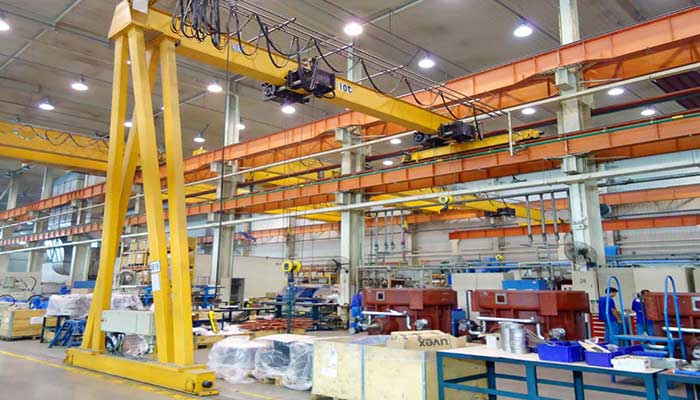
Typical Lifting Jobs by Capacity
1 ton semi gantry crane
- Small motors and pumps
- Light machine parts
- Repair tools and fixtures
- Small steel brackets
2 ton semi gantry crane
- Gearboxes and pumps
- Light welded frames
- CNC spare parts
- Bundled small steel sections
3 ton semi gantry crane
- Medium machine components
- Steel frames and supports
- Small molds
- Workshop maintenance lifting
5 ton semi gantry crane
- CNC machine parts
- Medium steel structures
- Motor and gearbox assemblies
- Medium molds and dies
- Fabricated platforms
10 ton semi gantry crane
- Large steel structures
- Heavy machine parts
- Press machine components
- Welded assemblies
- Industrial equipment modules
Why People Choose It
- Lower cost compared with double girder type
- Lighter structure, easier on existing workshop floor
- Easier installation in retrofit projects
- Good for general workshop lifting work
- Suitable for 1–10 ton normal applications
In most cases, this is the "standard workshop crane" choice.
Double Girder Semi Gantry Crane (Heavy Duty Workshop Use)
Where it is normally used: This type is used in heavier industrial workshops where lifting is frequent, loads are large, and safety control is more important. It is more rigid and stronger than single girder design.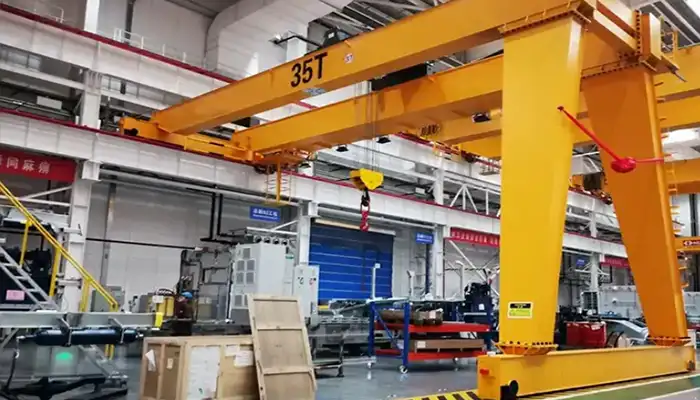
Typical Lifting Jobs by Capacity
10 ton semi gantry crane
- Large machine bodies
- Heavy gearboxes
- Steel structural sections
- Machine bases
- Large welded assemblies
15 ton semi gantry crane
- Press machine parts
- Heavy industrial frames
- Large molds and die sets
- Equipment modules
- Big fabricated structures
20 ton and above semi gantry crane
- Heavy steel beams
- Casting and forging parts
- Large industrial equipment
- Power plant components
- Heavy fabrication sections
Why People Choose It
- Higher lifting height in many designs
- Stronger and more stable structure
- Better for heavy and uneven loads
- Suitable for frequent lifting cycles
- Safer for demanding industrial use
This is usually chosen when lifting becomes part of daily production, not occasional work.
Simple Selection Guide (Quick Decision)
You don’t need a complicated process. In most workshop cases, it comes down to this:
- Light to medium parts, normal workshop work → Single girder semi gantry crane
- Heavy machines, large steel structures, frequent lifting → Double girder semi gantry crane
Also consider:
- How heavy your real loads are (not just maximum theoretical load)
- How often you lift every day
- How much space and ceiling height you have
- Whether the workshop is for general work or heavy production
Practical Note
In real workshop projects, the correct crane is usually not the biggest one. It is the one that fits your actual lifting job, your floor, and your space.
That is the main point when selecting a semi gantry crane in retrofit applications.
Consider Workshop Layout Constraints for Semi Gantry Crane Installation
In a retrofit workshop project, a semi gantry crane is always designed around the existing layout. Not the other way around. The building is already there, machines are already installed, and production is usually ongoing. So layout constraints directly decide how the semi gantry crane will move, lift, and operate. A small mistake in layout planning can lead to blocked travel paths or limited lifting access later.
Building Columns and Structural Limits
In most existing workshops, columns are fixed and cannot be moved. These columns often become the main control point for semi gantry crane design.
What you need to check:
- Column spacing across the workshop
- Column positions along crane travel direction
- Any uneven column alignment
- Clearance between columns and lifting zone
How it affects a semi gantry crane:
- Limits crane span in some areas
- Defines travel path of the crane leg
- May require partial coverage design instead of full-span operation
- Can affect turning or end-position clearance
In many retrofit projects, the semi gantry crane layout is basically "drawn between the columns."
Machinery Locations Inside the Workshop
Existing machines are usually the most sensitive part of a layout. Once installed, they are not easy to move, so the semi gantry crane must operate around them safely.
Key points to check:
- Position of CNC machines, presses, or welding stations
- Height and footprint of each machine
- Maintenance access space around equipment
- Any fixed workstations or heavy benches
Why this matters for a semi gantry crane:
- Prevents collision during load movement
- Ensures hook can reach the machine center safely
- Avoids tight turning or lifting angles
- Keeps maintenance lifting possible without repositioning equipment
In practice, the crane should "pass over and between" machines without interrupting production.
Material Flow and Working Routes
A semi gantry crane is not only for lifting. It is part of how materials move inside the workshop. So the material flow direction must be clear before final crane selection.
Typical movement areas:
- Incoming material unloading zones
- Cutting or fabrication areas
- Assembly stations
- Machine processing lines
- Finished product storage areas
What the semi gantry crane should support:
- Smooth loading and unloading operations
- Direct transfer between machines or stations
- Simple movement without blocking forklift routes
- Clear access for maintenance lifting tasks
If the material flow is not planned well, the semi gantry crane may end up working in the wrong area, which reduces its usefulness.
Practical Layout Note
In real retrofit projects, the semi gantry crane must fit into what already exists. Columns define the boundaries, machines define the working space, and material flow defines how the crane is actually used.
A good layout is simple: The crane moves freely, does not disturb production, and reaches every key lifting point without conflict.
Information Needed for Semi Gantry Crane Selection
When selecting a semi gantry crane for an existing workshop, especially in retrofit projects, accurate site information is essential. The crane design depends directly on real workshop conditions, not estimates. Incomplete or unclear data often leads to wrong span selection, insufficient lifting height, or unnecessary structural modification.
Workshop Data (Basic Site Dimensions)
These dimensions define the overall working range of the semi gantry crane.
What to provide:
- Workshop width (internal clear width): ____________ (example: 18 m)
- Workshop length (travel direction): ____________ (example: 60 m)
- Workshop height (floor to lowest obstruction): ____________ (example: 6.5 m to lowest beam)
- Workshop layout drawing (attached / yes / no): ____________ (example: Yes, CAD drawing available)
Why it matters:
- Semi gantry crane span
- Travel distance
- Working coverage area
- Overall layout feasibility
Even small measurement errors can affect lifting height and crane movement in real installation.
Load Information (What the Semi Gantry Crane Will Handle)
This section defines the crane capacity and structure type.
What to provide:
- Maximum load weight (heaviest lift): ____________ (example: 5 tons)
- Typical load types (steel / machine / mold / assembly): ____________ (example: CNC parts, steel frames)
- Load dimensions (approx. size): ____________ (example: 2.5 m × 1.5 m × 1.2 m)
- Lifting frequency (per day / shift): ____________ (example: 20–30 lifts per day)
Why it matters:
- Semi gantry crane capacity selection (1 ton to 20 ton range)
- Single girder or double girder design
- Duty class and motor sizing
- Structural safety factor
Floor Information (Very Important for Semi Gantry Crane Operation)
Since one side of a semi gantry crane runs on the floor, ground condition directly affects stability and safe operation.
What to provide:
- Concrete thickness: ____________ (example: 180 mm reinforced slab)
- Floor condition (good / cracked / uneven / unknown): ____________ (example: Good, minor surface wear)
- Floor reinforcement (if any): ____________ (example: Steel mesh reinforced)
- Rail installation possible (yes / no / not sure): ____________ (example: Yes, possible along main aisle)
Why it matters:
- Rail-mounted vs rail-free semi gantry crane selection
- Wheel load distribution design
- Need for floor reinforcement
- Long-term travel stability and maintenance cost
Electrical Information (Power Supply for Crane System)
Correct power supply ensures stable operation of the semi gantry crane system.
What to provide:
- Voltage: ____________ (example: 380V)
- Phase (single / three-phase): ____________ (example: 3-phase)
- Frequency (50Hz / 60Hz): ____________ (example: 50Hz)
- Power availability at workshop: ____________ (example: Available near workshop panel room)
Why it matters:
- Motor compatibility
- Hoist system selection
- Control panel design
- Electrical installation layout
Common Retrofit Challenges and Solutions for Semi Gantry Crane Projects
In real workshop retrofit projects, a semi gantry crane is almost never installed in a "clean" environment. The building already exists, machines are already running, and space is usually limited. So problems are normal. The key is not avoiding challenges, but matching each issue with a practical crane solution.
Semi Gantry Crane Retrofit Challenges and Solutions
| Challenge | Typical Situation in Workshop | Typical Solution for Semi Gantry Crane |
|---|---|---|
| Low ceiling | Old factory buildings, HVAC ducts, roof beams reduce lifting height | Use low-headroom hoist or double girder semi gantry crane to maximize hook height and improve lifting clearance |
| Weak floor | Old concrete floor, unknown reinforcement, uneven or cracked surface | Floor reinforcement (concrete upgrade or steel load distribution) or reduce wheel loads through optimized crane design |
| Limited space | Machines already installed, narrow aisles, partial working zones only | Custom span semi gantry crane design and limited travel coverage based on actual working area |
| Obstructions | Columns, machines, pipes, cable trays block crane movement | Customized layout design with adjusted travel path and lifting zones around fixed structures |
| Budget limitations | Need for cost control in small or medium workshops | Use single girder semi gantry crane with standard configuration and capacity matched to real maximum load |
Practical Note
In real semi gantry crane retrofit projects, these challenges are normal and expected. The correct solution is usually not changing the workshop, but adjusting the crane design.
A properly configured semi gantry crane will work around existing conditions and still support safe lifting, stable travel, and efficient material handling in daily operation.
Low Ceiling in Existing Workshop
Low ceiling is one of the most common issues in semi gantry crane installation, especially in old factories or buildings not originally designed for overhead lifting. When headroom is limited, lifting height becomes the main constraint.
Typical solution:
- Low-headroom hoist system for semi gantry crane
- Double girder semi gantry crane design for better hook height
Practical note:
A low headroom hoist can recover usable lifting height without changing the building. In tighter cases, a double girder structure helps improve hook approach and working clearance.
Weak or Uncertain Floor Condition
Many retrofit workshops have floors that were not designed for crane wheel loads. Some are old, some are uneven, and some have unknown reinforcement. Since one side of a semi gantry crane runs on the ground, this becomes a key safety point.
Typical solution:
- Floor reinforcement (concrete upgrade or steel distribution beams)
- Reduced wheel load design through crane optimization
Practical note:
If reinforcement is not possible, the crane design must be adjusted. Sometimes lowering travel speed or reducing load capacity is necessary for safe operation.
Limited Workshop Space
Space limitation is common in production workshops where equipment is already installed. There may be no straight open area for crane travel, or only partial zones available.
Typical solution:
- Custom span semi gantry crane design
- Partial travel coverage (working zone based design)
- Adjusted runway length according to real working area
Practical note:
A semi gantry crane does not always need to cover the full workshop. In many retrofit projects, it only serves one production zone or machine group.
Obstructions Inside the Workshop
Obstructions are almost always present in existing facilities. These include structural columns, machines, pipes, and overhead systems.
Typical solution:
- Customized semi gantry crane layout design
- Adjusted lifting path planning around fixed equipment
- Optimized girder height and travel route
Practical note:
The crane must move around what already exists. Good layout design avoids interference with production, maintenance access, and material flow.
Budget Limitations
Cost is always part of decision-making in semi gantry crane retrofit projects. Not every workshop needs a heavy-duty or high-spec system.
Typical solution:
- Single girder semi gantry crane for general applications
- Standard configuration instead of full customization
- Capacity selection based on real maximum load only
Practical note:
In many workshops, a properly sized single girder semi gantry crane (1–10 ton range) is enough for daily work like machine handling, steel parts movement, and general fabrication.
Practical Summary
In retrofit projects, challenges are expected. That is normal.
The real approach is simple:
- Low ceiling → adjust hoist or structure
- Weak floor → reinforce or reduce load
- Limited space → customize span and coverage
- Obstructions → redesign layout
- Budget limit → select single girder semi gantry crane when suitable
A well-designed semi gantry crane does not force changes to the workshop. It adapts to it.
Semi Gantry Crane Selection Checklist (For Quick Quotation)
Before requesting a semi gantry crane quotation, the basic workshop and operating data should be clearly prepared. This is especially important for retrofit workshops where space, ceiling height, and floor conditions are already fixed.
A complete input helps avoid wrong crane span, insufficient lifting height, or design changes during installation.
Semi Gantry Crane Buyer Checklist
| Item to Confirm | What You Need to Provide (Simple Input) | Example (Reference Only) |
|---|---|---|
| Workshop dimensions | Width, length, usable working area | (Width: 18 m, Length: 60 m, Working zone: machining area only) |
| Ceiling clearance | Floor to lowest obstruction height | (6.5 m to bottom of roof beam and cable tray) |
| Obstruction locations | Columns, machines, pipes, HVAC systems | (3 rows of columns, CNC machines along east side, overhead air pipes) |
| Floor condition | Concrete thickness, cracks, flatness, reinforcement | (180 mm reinforced concrete, good condition, minor surface wear) |
| Required lifting height | Maximum hook height needed in real work | (4.5 m hook height needed for machine installation) |
| Lifting capacity | Maximum load weight (tonnage) | (5 ton for CNC parts and steel frames) |
| Travel length | Crane movement distance in workshop | (45 m travel along main production line) |
| Power supply details | Voltage, phase, frequency | (380V, 3-phase, 50Hz available near workshop panel) |
For a semi gantry crane, half gantry crane, or single girder gantry crane, missing even one key detail can affect final design accuracy.
In real workshop projects, this checklist helps ensure:
- Correct crane configuration (single or double girder)
- Proper lifting height for low ceiling conditions
- Safe wheel load design based on floor strength
- Faster quotation without repeated clarification
A clear checklist like this is usually enough to start a proper semi gantry crane design directly from real workshop conditions.
A successful semi gantry crane retrofit starts with understanding the workshop, not the crane. By evaluating ceiling height, floor conditions, and layout constraints first, buyers can select the most practical and cost-effective semi gantry crane while avoiding unnecessary building modifications and installation problems.
Send Us An Inquiry on Semi Gantry Cranes
Customer Information Form (Fill-in Section for Semi Gantry Crane Inquiry)
You can copy and fill this section when requesting a quotation for a semi gantry crane, half gantry crane, or single girder gantry crane.
Company Name: ___________________________
Contact Person: ___________________________
Email / Phone: ___________________________
Country / Location: ___________________________ (example: USA, California)
Workshop Width: ___________________________ (example: 18 m)
Workshop Length: ___________________________ (example: 60 m)
Workshop Height: ___________________________ (example: 6.5 m)
Layout Drawing Available: YES / NO (example: YES, PDF attached)
Max Load Weight: ___________________________ (example: 5 tons)
Load Type: ___________________________ (example: steel parts, CNC components)
Load Size: ___________________________ (example: 2.5 m × 1.5 m × 1.2 m)
Lifting Frequency: ___________________________ (example: 25 lifts/day)
Floor Thickness: ___________________________ (example: 180 mm concrete slab)
Floor Condition: ___________________________ (example: good condition)
Rail Required: YES / NO / NOT SURE (example: NO)
Voltage: ___________________________ (example: 380V)
Phase: ___________________________ (example: 3-phase)
Frequency: ___________________________ (example: 50Hz)
In semi gantry crane retrofit projects, accurate information reduces design mistakes and avoids changes during installation.
When workshop size, load details, floor condition, and electrical data are clearly provided, the semi gantry crane design becomes more precise, and installation in an existing workshop is smoother with fewer adjustments on site.

Article by Bella ,who has been in the hoist and crane field since 2016. Bella provides overhead crane & gantry crane consultation services for clients who need a customized overhead travelling crane solution.Contact her to get free consultation.